2024-06-02
Impact of data and evidence on operations and policies in the context affected by the forced displacement of populations in sub-Saharan Africa, more precisely in DR Congo
Poor and highly vulnerable countries in sub-Saharan Africa like the Democratic Republic of Congo, South Sudan and others face armed conflicts, natural disasters, pressing climate events, human rights abuses, multifaceted violence, epidemics,...causing massive displacements of populations, leading these countries into very acute food, security and health crises, thus accentuating extreme poverty of the populations.
Impact of data and evidence on operations and policies in the context affected by the forced displacement of populations in sub-Saharan Africa, more precisely in DR Congo
Manager Communication of REPONGAC
Summary
Poor and highly vulnerable countries in sub-Saharan Africa like the Democratic Republic of Congo, South Sudan and others face armed conflicts, natural disasters, pressing climate events, human rights abuses, multifaceted violence, epidemics,...causing massive displacements of populations, leading these countries into very acute food, security and health crises, thus accentuating extreme poverty of the populations.
Failure to comply with established laws and policies rarely provide adequate solutions for displaced people and their planned resettlements.
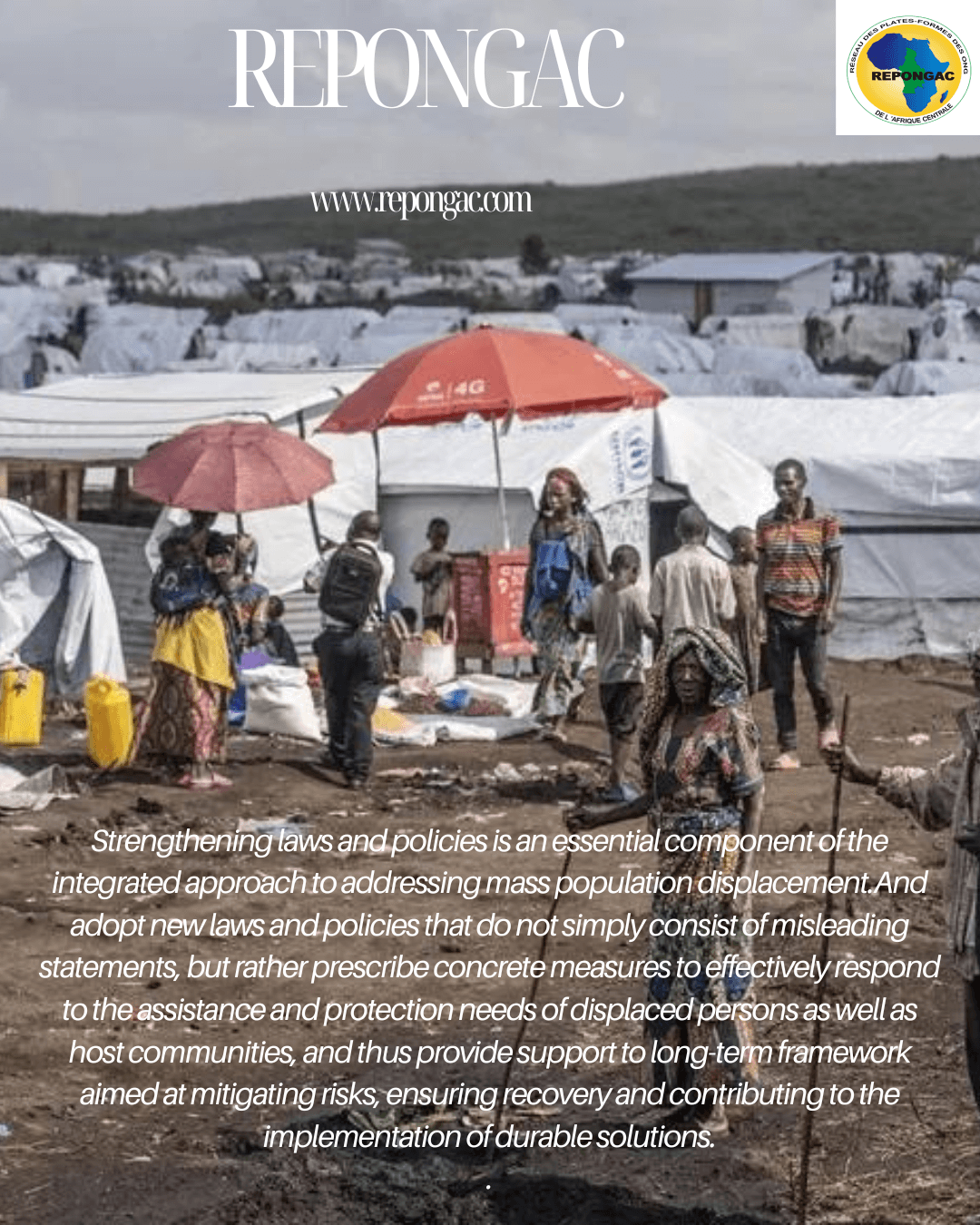
Strengthening laws and policies is an essential component of the integrated approach to addressing mass population displacement.And adopt new laws and policies that do not simply consist of misleading statements, but rather prescribe concrete measures to effectively respond to the assistance and protection needs of displaced persons as well as host communities, and thus provide support to long-term framework aimed at mitigating risks, ensuring recovery and contributing to the implementation of durable solutions.
Context
Every year, millions of Africans are forced to flee their homes due to violence, armed conflict or natural disasters, whether sudden events like armed conflicts, floods, volcanic eruptions , or slowly evolving phenomena linked to climate change.
Disasters of human or natural origin, human rights violations, widespread violence, armed conflicts, epidemics, etc. are the main and most frequent causes that displace many Africans.
Reports from the United Nations and humanitarian organizations indicate that, in recent years, more than 7 million Congolese have been displaced by armed conflicts and natural disasters, making the DRC one of the most acute humanitarian crises in the world.
Although the vast majority of these displaced people are internally displaced, it should be noted that the DRC receives refugees from border countries and the available data does not make it possible to determine the exact number of people who have moved from one country to another following armed conflicts or disasters.
Exactly, in the DRC, the causes of massive population displacements are: armed conflicts in the provinces of Ituri, North and South Kivu, inter-ethnic conflicts between the Téké and Yaka tribes in the Provinces of Maïndombé, Kwilu and Kwango and in Katanga province;Natural disasters such as volcanic eruptions in the province of North Kivu, floods, landslides, violent winds in the city province of Kinshasa, in Ituri, in Kasai, North and South Kivu, etc.
The consequences of these displacements have devastating effects on the displaced as well as the communities that host them. Many of these displaced people need assistance and protection in essential areas such as emergency shelter, health and psychosocial support, access to drinking water and sanitation, protection against violence. (gender-based violence), child protection and education.
They also need long-term support, such as land and property rights, to recover and benefit from durable solutions. Finally, these displacements have a major impact on the most vulnerable people, such as women, children, the elderly, minority groups, people with disabilities and those with health problems.
The most notable facts of forced displacement in the DRC
The constant deterioration of the humanitarian and protection situation for forced displaced persons in the DRC is mainly marked by violations and abuses perpetrated against these displaced persons in camps, host villages, etc. by armed attacks and/or disasters. natural resources, continues to worry the humanitarian community in recent years.
The most striking facts collected through interviews and testimonies of displaced people who are victims of human rights violence and violations committed against vulnerable people (women, girls, children, elderly people, disabled people, etc.) causing these massive and forced displacements are The following :
-In Great North Kivu, attacks by alleged ADF elements against displaced civilians in camps and host communities. Leadership conflicts within armed groups in the territories of Lubero and Béni as well as regular clashes between two factions of the Mai-Mai which continue to affect displaced civilians, especially in the territory of Lubero.
-In Little North Kivu, clashes between armed groups in the South East and South West of Masisi, repeated violations of civil character, especially sexual violence against women and girls in displaced persons (IDP) sites by armed actors of Katale. In the South of Masisi, cases of extortion of cash distributed to IDPs, cases of kidnappings in Virunga Park and in the Walikale areas, acts of reprisals in the South-West part of Rutshuru.Overall, the strengthening of armed groups in areas where the withdrawal of the EAC force was expected in the event of non-renewal of their mandate, constitutes a threat to the protection of displaced people and people living in these areas, particularly in the Masisi.
-In South Kivu, the activism of armed groups and the human rights violations that follow, fires in displaced sites caused by the precariousness of unsustainable shelter facilities as well as tensions due to land conflicts caused havoc in August 2023.
-In the province of Ituri, mainly in the territories of Djugu, Mahagi and Irumu, elements of the armed groups CODECO/URDPC, Zaire and FPIC distinguished themselves by attacks on villages and ambushes on the main roads accompanied by murders, assault and battery, looting, kidnapping and burning against the displaced and their property.Furthermore, elements of the ADF armed group were particularly active in the territory of Irumu, notably in the Komanda health zone, and in the territory of Mambasa, particularly in the Mandima health zone, where acts of kidnappings, murders, assaults and pillaging of the property of displaced populations and communities living in these areas are attributed to them.
-The continuation of conflicts between the Yaka and the Téké in the territory of Kwamouth leading to forced displacement of populations and the activism of Mobondo militiamen in the provinces of Kwango, Kwilu and Maï-Ndombe perpetrating atrocities in villages.
-In the provinces of Kasaï, Kasaï-Central and Kasaï-Oriental: the arrival of Congolese expelled from Angola for irregular status causes cyclical intra- and intercommunity conflicts which negatively influence peaceful cohabitation and cause cycles of forced displacement of populations with , among other consequences, an increase in the vulnerability of populations.These include customary power conflicts, land conflicts and a constant increase in cases of kidnapping (particularly of minors) in the provinces of Kasaï (Tshikapa), Kasaï-Central (Kananga) and Kasaï Oriental (Mbuji- Mayi).
-The persistence of intercommunity conflicts in the territories of Kalemie (Nyemba health zones) and Moba (Kansimba health zones) in Tanganyika. Actors monitoring the protection of forcibly displaced persons reported approximately 18,835 violations and incidents in August 2023.
-Approximately 10,545 human rights violations including 335 alerts of gender-based violence have been documented in the territories (respectively Kalehe, Uvira, Mwenga, Walungu, Shabunda and Fizi) in the province of Ituri. A general increase of 3,660 cases compared to the month of July 2023 (with 6,885 cases) is thus noted, or 53.15%.
-Natural disasters and epidemics cause enormous forced displacement and human and material damage, they generate socio-economic, political and cultural consequences in all provinces in the DRC and everywhere else in sub-Saharan African countries such as eruptions volcanics, floods, landslides, violent winds,... and endemic diseases such as Ebola hemorrhagic fever, cholera, monkey virus,...
In view of the above, this article aims to denounce all forms of violence against displaced people and the resulting socio-economic and political consequences through information, training and communication actions with the aim of fighting against social norms harmful to the rights of men, women and girls and to strengthen their roles in the prevention and denunciation of cases of violence identified in their environments with a view to contributing to the application of laws aimed at improving protection of forcibly displaced people and to benefit from their decision-making at different levels which can be engaged in accountability mechanisms.
Thus, in order to respond effectively to this challenge, the DRC had adopted laws, policies or strategies relating to the protection of forcefully displaced persons. Instruments guide the Congolese authorities and other parties involved in the intervention, and these tools guarantee the rights of IDPs, as defined in 1998 by the United Nations.
As an auxiliary of public authorities in Central Africa, and due to our roots in the grassroots communities we serve, Repongac is better placed to:
1) carry out awareness-raising activities for people who are victims of forced displacement;
2)advocate for the adoption of stronger laws and policies for managing the risks of armed conflict and other hazards, which ensure legal preparedness for conflicts and provide solutions for those displaced by armed conflicts and natural disasters.
Conclusion
Forced displacement is a phenomenon that poses enormous challenges in Sub-Saharan Africa and the DRC, it destroys all sectors of life, threatens the well-being and functioning of institutions, communities and has profound effects on socio-development. economic and political of countries.Talking about development in a country very often the victim of forced displacement of populations for more than 30 years is a real challenge for the Congolese authorities, and this requires all-round involvement of all stakeholders for effective and sustainable development.